One Happy Island - Aruba
7/3/2026 - 7/9/2026
Every year, Carmen goes on a trip with some friends. They are always beach vacations. I always pass. This year, I decided to tag along. It was their second trip to Aruba, and they talked about how nice it was the first time. I am almost always up for adding another country to my travel list. This was my 27th/28th country visited; depending on how you feel about Taiwan. All in all, it was a nice place to visit. Aruba calls itself "One Happy Island", but they could use some more birds, for my liking.
We are staying at a resort. It is all the food and drinks you can handle - and more than some could handle. It is not really my scene. The lounging at the pool loses its novelty after a bit. The overeating - same. It is windy here. Seems the average day is a constant 10-15 mph wind. On windy days, it is much higher. We had a couple of those. If you are into sunshine, limited rain, and beaches, this might be your place. If you are into birds and are not much of a beach person, your mileage may vary. The island is scenic. It is very dry and sees little rain; although it rained several times while we were there. You could watch the rain come in as a white veil sweeping across the landscape. It would hit and pour for a minute or two; then it was over. If you are alert, your drink may not even get watered down much.
Aruba sits about 18 miles off the coast of Venezuela, and the island holds a small mix of South American and Caribbean species. There are no endemic birds there. I made it out to bird three mornings and found 39 species, of which 6 were life records. Birding was limited to areas at the resort, a small sanctuary across the road, and a trip to Spaans Lagoon.
Bubali Bird Sanctuary -
The sanctuary was practically across the road from where we stayed. I feel there is more to this place than I discovered. There is one small trail on the south side of the sanctuary that dead-ends at nothing. On the west side, there is a road that leads to a 2-story observation tower. There is a secondary area there where people come and feed ducks, and it is swarming with White-cheeked Pintail and feral Muscovy Duck. The sanctuary itself is a large brackish lagoon that is mostly surrounded by tall hedges of vegetation. Visibility in the areas I visited were limited to the feeding area and the tower.
I saw most of my species from the trip here. The feeding area, in addition to the ducks, had Snowy Egret and Green Heron. Walking the road back, you could hear many of the recently split Mangrove Yellow Warbler. Seeing one was a different story. Bananquit, Black-headed Grassquit, Bare-eyed Pigeon, and Carib Grackle were easily found, too. The observation tower provided a good viewpoint to watch the water. Great Blue and Green Herons, Great and Snowy Egrets, Black-necked Stilt, Magnificent Frigatebird, an assortments of terns ("Cayanne" Sandwich, Common, and Least), and a few Laughing Gull were fairly common. Standing in the tower and given enough time, I am sure I could have pulled a few more species. Black Skimmer came through for a couple of passes, and three Roseate Spoonbill flew up out of nowhere, once.
Here is what I got of the more common species.
Black-faced Grassquit Bare-eyed Pigeon Bananaquit Black-faced Grassquit Bare-eyed Pigeon Carib Grackle Bare-eyed Pigeon Bare-eyed Pigeon Carib Grackle Banaquit Tropical Mockingbird Black-faced Grassquit
Gray Kingbird were also present both times I visited. On the second morning, I had a pair of rather cooperative birds. The beetle did not fit and was eventually dropped.
Gray Kingbird Gray Kingbird Gray Kingbird Gray Kingbird
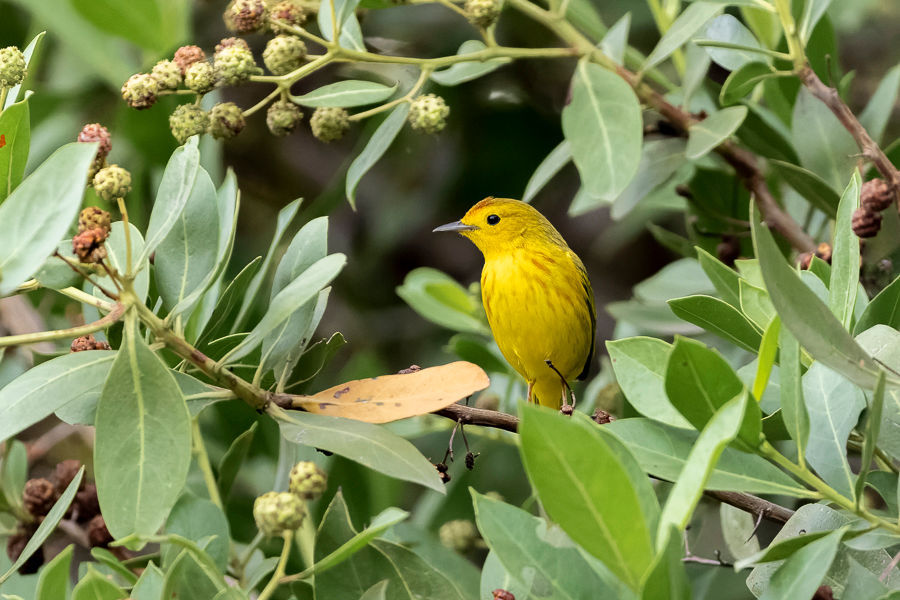
Mangrove Yellow Warbler was a target species for me. With the recent split, this was a new bird for me. It should have been easier to get a decent shot, but the winds were gusting into the 30 mph range the first day I was there. It was hard to even keep the bird in frame.
Mangrove Yellow Warbler Mangrove Yellow Warbler
Finally, on my second visit, I found a bird framed-up in a bush along the road in.
Norther Scrub Flycatcher was also a life bird for me. It was not difficult to find. It was also not overly shy, but it would keep a bit of distance. The largest challenges on this bird were the lighting (it hid up in the undersides of the trees) and that the bird is an expert at posing with weird head angles. I am not overly happy with any of the shots, but I am happy to have seen and photographed the bird.
Northern Scrub Flycatcher Northern Scrub Flycatcher

Venezuelan Troupial was also a new species for me. The species here is an exotic but countable. Apparently, the ones in Puerto Rico do not enjoy the same status. It is a beautiful, but somewhat comical-looking species. I was lucky to run across a pair near the entrance.
Venezuelan Troupial Venezuelan Troupial Venezuelan Troupial Venezuelan Troupial
I apparently had one rarity this trip; although I did not realize it until a little bit ago. I have a pic of a Tropical Kingbird. I did not recall adding it to my eBird report, though. On checking, I saw it was missing and went to add it. It was not an option, which is probably why I missed listing it to begin with. I got the bird added once I included rarities in the list and uploaded the photo for documentation. I am not sure if it is generally rare or rare for this time of year.

While birds were my main focus, I could not help but notice the number of lizards at Bubali. I photographed two species there but am fairly sure we had four. The predominant species was the endemic Aruban Whiptail, which is a nice looking lizard. I am unsure on the species of the other ones.
Aruban Whiptail Aruban Whiptail Aruban Whiptail Aruban Whiptail
Between visits to Bubali, I headed to Spaans Lagoon and had a decent morning. I paid my second visit to the sanctuary right before we were flying home. I had done fairly well at finding my targets, but I was missing one species that I was sure I should have seen and could be found here. I walked into Bubali with a lot of hope. It seems to happen fairly often that things work out just as you give up on them. I did not have much time that morning. About an hour and a half before I had to meet everyone for breakfast. I had visited the tower and walked the road a bit; trying to get decent photos of that Norther Scrub Flycatcher. No joy. I was walking out and was just about to the front entrance when a pair of bird burst out of the wall of vegetation just ahead of me. They flew into a somewhat open area that has a tree where I had photographed Bare-eyed Pigeon the day before. I was sure I knew what they were immediately. There is only one native parrot species on the island; although there are a couple of exotics. These turned out to be my lifer Brown-throated Parakeet - the bird I was hoping for. They did not seem overly happy to be seen, but I was happy to see them. I happily snapped a few shots before they gathered themselves and flew away, and then I headed to the breakfast buffet.
Brown-throated Parakeet Brown-throated Parakeet

Spaans Lagoon -
Spaans Lagoon is about 13 km (as they measure it) or 8 miles (as I would measure it) from where we were staying. I would need a taxi. There is no Uber service in Aruba. Taxis are hard to get, and they are expensive. To get to the lagoons and back, it is going to cost me about $100 roundtrip. I did overtip a bit on the way out, but I wanted to make sure the driver was motivated to come pick me up at the time I set.
The lagoon is listed as one of the best places to bird on the island. Several species are best found here: Ruby-topaz Hummingbird, Yellow Oriole, and Blue-tailed Emerald. Burrowing Owl, the national bird of Aruba (called "Shoco"), is also found here. Carmen and I were dropped off at the Balashi Gold Mill just after sunrise and gave the driver a three hour time limit. We did not need that long here; although, I did have a couple of misses. So, maybe I needed longer.
The owls were easy to find. They have abandoned their original burrows and are now burrowing next to the parking lot. The curse of the tropics and air conditioning about ruined my initial pics. The entire camera (most specifically the front lens) was coated in condensation as soon as I pulled it out of my pack. It was a lot of cleaning the lens and hoping it would warm soon before I could get pics. There were four birds there, total. I am not sure where else they are found on the island, but this seems like a very small population.
Burrowing Owl Burrowing Owl Burrowing Owl
As I mentioned, I had a few misses here. Of them, Yellow Oriole is the one I am most disappointed in. It would have been a lifer, and it is reasonably common. The emerald would have been nice to see, I have only seen this species in Brazil a decade ago. Caribbean Elaenia probably counts as a miss, too, but it is not overly common. I know the oriole was seen here the morning we were there, as another birder had seen a pair.
My issue was that I was overly focused on one species. The Ruby-topaz Hummingbird. It is a beautiful hummingbird and also a lifer. The problem is that I was sure we saw one almost immediately when we arrived. The sun was not quite over the edge of the hills, yet. The bird was not well lit, and it was distant. The hummingbird zoomed by, poked at a cactus flower, perched very briefly, and then took off. I staked out that cactus for way too long. The bird never came back, but I was convinced it would. I eventually scouted around the area a bit more and easily found another. I had just wasted a good portion of time waiting in the wrong spot. This is the best shot I got of my number one target for the island. I was happy to see it iridesce so brilliantly.
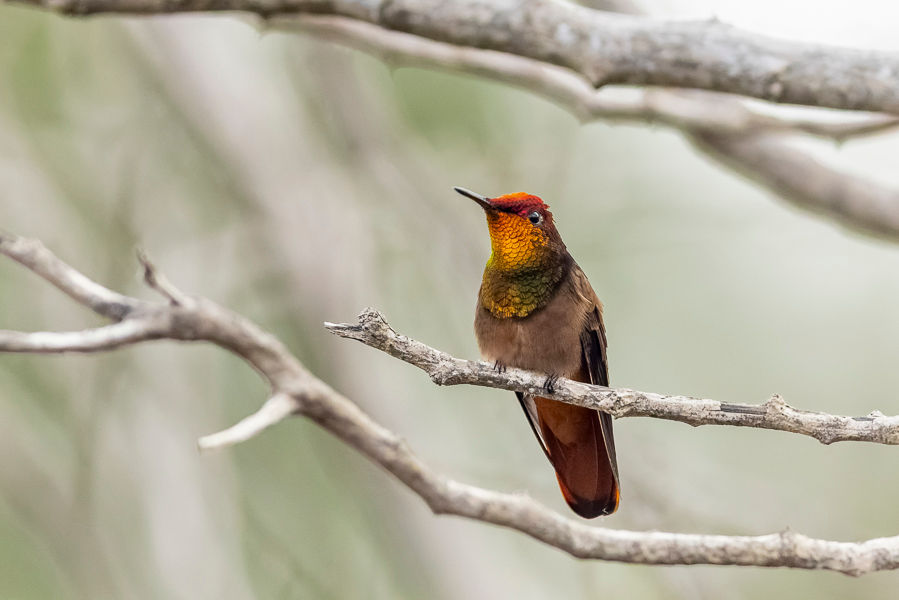
All in all, I think I had about 4 individuals. They were constantly perched or chasing each other. I never saw one feeding.
Ruby-topaz Hummingbird Ruby-topaz Hummingbird Ruby-topaz Hummingbird Ruby-topaz Hummingbird
While waiting, I did have Brown-crested Flycatcher. There were a number of Black-faced Grassquit and Mangrove Yellow Warbler, as well. After finding the hummingbird, we walked down to the lagoon and along a trail. The trail held nothing but mosquitoes. We walked a couple hundred yards and then turned back. By this point, we had used up most of our time. I headed back to look for more birds to shoot, and Carmen went to explore the ruins of the gold mill.
Black-faced Grassquit Brown-crested Flycatcher Bare-eyed Pigeon Black-faced Grassquit Tropical Mockingbird Burrowing Owl Common Ground Dove
The weather turned hot, and things slowed down. I really could have used another morning at this location. On the other hand, it was expensive to get there. As we were waiting and hoping for the taxi driver to come pick us up, and small herd of feral goats wandered by. Carmen wanted to make sure I got pics of them.
That is all for this trip. Just the two locations to share and a few pics. Overall, the island was nice. The people are friendly, and I always felt really safe. It was not the most strenuous trip, but there is something to be said for that. The birding was easy, and they have some good birds. There is at least one other location to bird on the island, Baby Beach, but it was on the opposite end from where we were staying. I am not sure what a cab ride that far would have cost. Maybe if I find myself back on the little happy island again, some day.
I have crammed all of my vacation time into the middle of the year. So, I am heading back out in a month for the final trip of the year. Hopefully, I come back with a load of good photos and some new birds to share.
Thanks for reading,
Mike


Comments